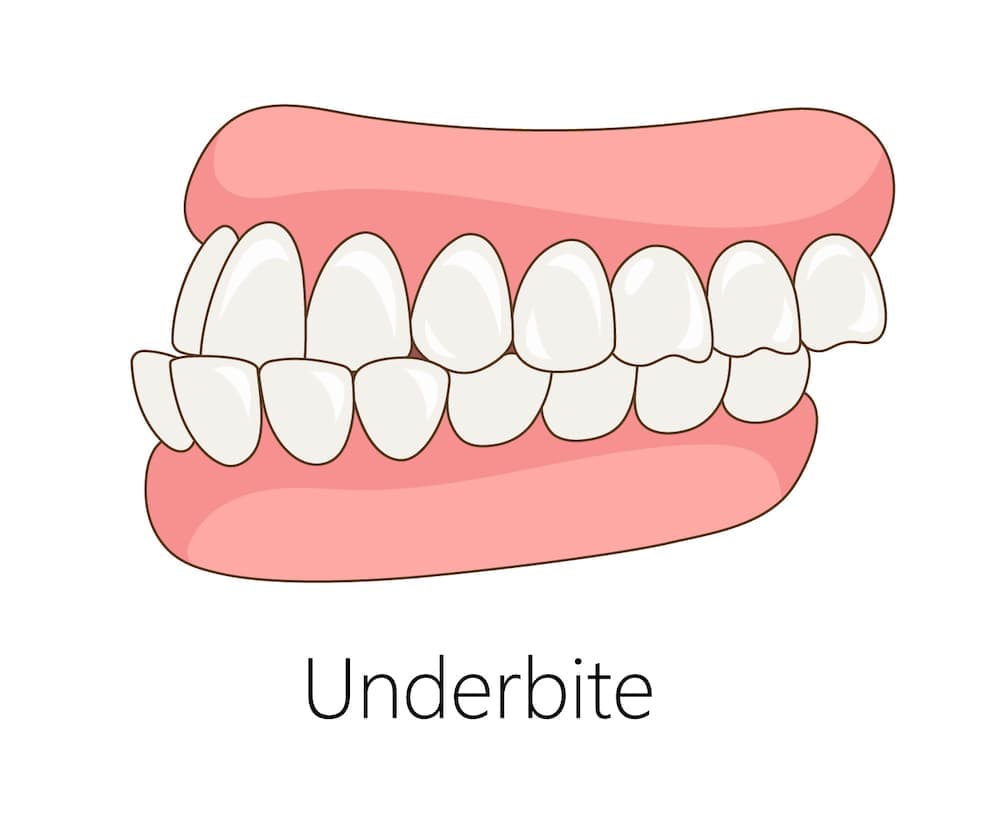
An underbite is a common orthodontic condition where the lower front teeth sit in front of the upper front teeth when the mouth is closed. In a healthy, well-aligned bite, the upper teeth should overlap the lower teeth slightly. An underbite reverses this relationship, and the result can affect everything from the way you chew and speak to the balance of your facial profile.
So what is an underbite, exactly? It is a type of malocclusion — a misalignment of the teeth and jaw — that causes the lower jaw or lower teeth to project forward beyond the upper teeth. Underbite teeth may appear noticeably out of alignment, with the lower front teeth sitting visibly ahead of the uppers. The condition can range from a mild discrepancy that is barely noticeable to an extreme underbite that significantly affects function and appearance.
Underbites are seen in both children and adults. Whether caused by genetics, jaw growth imbalance, or childhood habits, early assessment is valuable because timely intervention — particularly during childhood development — can simplify treatment and improve outcomes. This guide covers everything you need to know: causes, symptoms, diagnosis, and the full range of treatment options available.
Underbite vs Overbite — What's the Difference?
Understanding the difference between an overbite and underbite is important because they are essentially opposite conditions, and each requires a different treatment approach. If you have ever wondered “how do I know if I have an overbite” or “how do you know if you have an overbite”, the answer lies in observing where your teeth sit when your jaw is fully closed.
In a normal bite, the upper front teeth sit slightly in front of and overlap the lower front teeth by around 2–4mm. This small degree of overlap is healthy and allows for comfortable biting and chewing.
An overbite occurs when the upper teeth overlap the lower teeth excessively — often covering them significantly or even contacting the gum. An underbite is the reverse: the lower teeth and jaw project forward, sitting in front of the upper teeth.
How to know if you have an overbite versus an underbite? Look at your bite in a mirror when you close your mouth naturally. If your lower teeth sit visibly in front of your upper teeth, you likely have an underbite. If your upper teeth cover a large proportion of your lower teeth, you may have an overbite.
| Classification | Tooth Position | Characteristics |
|---|---|---|
| Normal Bite | Upper teeth slightly overlap lower teeth (2–4mm) | Comfortable bite function; even contact; no treatment needed |
| Overbite | Upper teeth excessively overlap or cover lower teeth | Deep vertical overlap; lower teeth may contact gum; jaw strain |
| Underbite | Lower teeth sit in front of upper teeth | Reversed bite relationship; chin may appear prominent; chewing difficulty |
What Causes an Underbite?
Underbites develop for a variety of reasons, and the underlying cause determines the most effective treatment approach. In many cases, more than one factor contributes to the condition.
Causes in Children
- Genetics — The most common cause of underbite is hereditary. Jaw size and shape are largely inherited, and a child may develop an underbite simply because the lower jaw is genetically larger or grows further forward than the upper jaw. A family history of underbite significantly increases the likelihood
- Jaw growth differences — During childhood development, the upper and lower jaws may grow at different rates. If the lower jaw outpaces the upper, the lower teeth gradually move forward, creating an underbite jaw discrepancy that becomes more apparent over time
- Thumb sucking and oral habits — Prolonged thumb sucking, tongue thrusting, or dummy use can influence the developing jaw, altering the position of the teeth and potentially contributing to a bad underbite as the child grows
Causes in Adults
- Untreated childhood bite issues — An underbite that was not addressed during childhood can persist and worsen in adulthood as the jaw finishes developing. What may have been a mild underbite in childhood can become a more pronounced underbite jaw problem over time
- Jaw growth imbalance — In some adults, the lower jaw is naturally larger or more forward-positioned than the upper jaw, resulting in a skeletal underbite that affects both tooth alignment and facial balance
- Tooth loss — Missing upper teeth can allow the lower teeth to drift forward, creating or worsening an underbite. Without the opposing teeth providing balance, the bite can shift over time
Key point: Whether an underbite is caused by genetics, jaw development, or habits, it is a treatable condition. Identifying the cause helps guide the most effective correction approach.
Signs and Symptoms of an Underbite
The symptoms of an underbite can range from subtle to significant, depending on the severity. A mild underbite may cause few noticeable issues, while a severe underbite or extreme underbite can have a substantial impact on both function and appearance.
Functional Symptoms
- Difficulty chewing — When the lower teeth sit in front of the upper teeth, biting into food and chewing efficiently becomes challenging. Patients with severe underbites often compensate by chewing on one side or tearing food rather than biting cleanly
- Speech challenges — An underbite can affect the way certain sounds are formed, particularly “s”, “f”, and “th” sounds, potentially causing a lisp or unclear pronunciation
- Jaw discomfort — The misaligned bite places strain on the jaw joints and muscles, leading to aching, clicking, or tension — particularly after eating or during periods of stress
- Tooth wear — Underbite teeth that do not meet correctly place uneven force on certain areas, causing premature wearing, chipping, or even fractures over time
Aesthetic Concerns
- Prominent chin or lower jaw — A noticeable underbite can cause the chin and lower jaw to appear more prominent or forward-positioned than expected, affecting the side profile
- Facial imbalance — In more pronounced cases, the relationship between the upper and lower face may appear out of proportion, though the degree of visible impact varies from person to person
- Visible reversed bite — When the lower teeth sit clearly in front of the upper teeth, this may be visible when smiling or speaking, which can affect confidence in social situations
Important: Even if your underbite does not cause discomfort right now, having it assessed is worthwhile. Untreated underbites can worsen over time, and treatment is often more straightforward when started earlier.
How Is an Underbite Diagnosed?
Diagnosing an underbite involves a thorough clinical examination of your teeth, bite, and jaw. Your dentist will assess how your upper and lower teeth meet when you close your mouth naturally and evaluate the overall relationship between your jaws.
The assessment typically includes:
- Clinical bite examination — Observing the position of the teeth when you bite down naturally to identify whether the lower teeth sit in front of the upper teeth and by how much
- Visual assessment — Evaluating the overall alignment of the underbite teeth and noting any visible asymmetry or reversed bite relationship
- Measurement of jaw alignment — Assessing the spatial relationship between the upper and lower jaws to determine whether the underbite is dental (caused by tooth positioning) or skeletal (caused by jaw size discrepancy)
- Underbite jaw positioning evaluation — Determining whether the lower jaw is naturally larger, further forward, or both, which helps classify the severity and guide the treatment plan
Important for children: Early assessment of an underbite in children is particularly valuable. Because the jaw is still developing, identifying the condition early may allow for growth-guidance interventions that can reduce severity and simplify future treatment.
Can an Underbite Be Fixed Without Surgery?
One of the most common questions patients ask is how to fix an underbite — and specifically whether underbite correction can be achieved without surgical intervention. The answer depends entirely on the type and severity of the condition.
When non-surgical treatment is possible: Many underbites — particularly mild to moderate cases caused primarily by tooth positioning — can be corrected without surgery. Orthodontic treatment with braces, clear aligners, and bite-correcting elastics can reposition the teeth and improve the bite relationship effectively. How to correct underbite without surgery is achievable for a significant number of patients through these approaches alone.
When more complex care may be needed: An extreme underbite or severe skeletal underbite caused by a significant jaw size discrepancy may not be fully correctable through orthodontics alone. In these cases, corrective jaw surgery (orthognathic surgery) may be recommended alongside orthodontic treatment to reposition the jaw and achieve a stable, functional result.
Age factors: In children, early intervention during jaw development may harness natural growth to guide the jaw into a more favourable position, potentially avoiding the need for surgery later. In adults whose jaw growth is complete, the treatment options are determined by the degree of skeletal involvement.
Please note: The suitability of non-surgical treatment depends on the individual case. Your dentist will always explore the least invasive options first and recommend surgery only when orthodontics alone cannot achieve the required correction. How to fix underbite effectively starts with an accurate clinical assessment.
Braces for Underbite Correction
Fixed braces are one of the most effective and widely used treatments for correcting an underbite. Do braces fix underbite? Yes — and they remain a gold-standard approach for a wide range of underbite severities.
How Braces Correct an Underbite
Underbite braces work by bonding brackets to the teeth and connecting them with an archwire that applies controlled, continuous force. This gradually moves the teeth into improved positions, correcting the reversed bite relationship. Can braces fix an underbite? Absolutely — and the precise control offered by fixed braces makes them suitable even for more complex cases.
Elastics and Bite Correction
Braces for underbite correction frequently incorporate orthodontic elastics — small rubber bands that attach to the upper and lower brackets. These elastics apply directional forces that help pull the lower teeth back and the upper teeth forward, working to close the reversed bite. Consistent wear of elastics as directed is critical for achieving the desired result.
Treatment Timeline
The duration of underbite braces treatment varies depending on the severity of the condition. Mild cases may be corrected in a shorter timeframe, while more complex underbites require longer treatment to achieve stable results. Your dentist will provide a realistic estimate based on your individual case during your consultation.
Key point: Fixed braces remain one of the most reliable methods for underbite correction across all severity levels. They offer precise control over tooth movement and can be combined with elastics and appliances for comprehensive bite correction.
Can Invisalign Fix Underbite?
Can Invisalign fix underbite? In many cases, yes. Invisalign and other clear aligner systems can be effective for correcting mild to moderate underbites, particularly those caused by tooth positioning rather than significant skeletal jaw discrepancy.
Clear aligners work by applying controlled pressure through a series of custom-made removable trays. Each set moves the teeth gradually toward their target position. For suitable underbite cases, they offer a discreet and comfortable underbite treatment alternative to fixed braces.
However, Invisalign may not be suitable for all underbites. Severe or skeletal underbites that involve a significant jaw discrepancy may require fixed braces — or a combined orthodontic and surgical approach — for effective correction.
| Factor | Fixed Braces | Invisalign |
|---|---|---|
| Suitability | All severities including severe and extreme underbite | Mild to moderate underbite cases |
| Visibility | Visible brackets and wires (ceramic options available) | Nearly invisible clear trays |
| Removable | No — fixed throughout treatment | Yes — removed for eating and cleaning |
| Elastic use | Commonly used for bite correction | Can be used with compatible aligner systems |
| Compliance needed | Minimal — always working | High — must be worn 20–22 hours per day |
| Best for | Complex, severe, or skeletal underbite correction | Discreet correction of mild to moderate underbite |
Which is right for you? Your dentist will recommend the most suitable option after a thorough clinical assessment. The choice between braces and Invisalign depends on the type, severity, and underlying cause of your underbite.
How to Fix Underbite Naturally — Is It Possible?
Many patients search for how to fix underbite naturally, hoping that exercises, jaw positioning techniques, or lifestyle changes can correct the condition without professional treatment. It is important to address this topic honestly and responsibly.
The reality: Exercises and jaw movements alone cannot correct a structural underbite. An underbite is caused by the physical position of the teeth, the size and shape of the jaw, or both. These are anatomical factors that require orthodontic intervention to change. No amount of jaw exercises, facial stretching, or self-directed techniques can reposition the bones or move the teeth into a corrected alignment.
What may help: In young children whose jaws are still developing, early orthodontic intervention can help guide jaw growth in a more favourable direction. This is not a “natural” fix in the way many online sources suggest, but it does use the body's natural growth process to support correction. Growth-guidance appliances and early orthodontic assessment are the most effective way to take advantage of this window.
Important: Be cautious of online claims suggesting that underbites can be fixed at home through exercises or devices purchased without professional guidance. These approaches are not evidence-supported and may delay effective treatment. If you are concerned about an underbite, the safest and most effective first step is a professional clinical assessment.
What Happens If an Underbite Is Left Untreated?
A bad underbite that is left unaddressed does not typically improve on its own — and in many cases, it worsens progressively over time. The longer a severe underbite or extreme underbite goes without treatment, the greater the risk of complications.
- Jaw strain and TMJ discomfort — The misaligned bite places chronic strain on the jaw joints and muscles, leading to pain, clicking, locking, and tension headaches over time
- Accelerated tooth wear — Teeth that do not meet correctly bear uneven force, causing premature wearing of the enamel, chipping, and potential fractures
- Speech problems — An untreated underbite can cause or worsen speech difficulties, affecting clarity and confidence in communication
- Facial imbalance — As the bite worsens, the visual impact on the facial profile can become more pronounced, with the lower jaw appearing increasingly prominent
- Worsening alignment — Without correction, the teeth and jaw can continue to shift, making eventual treatment more complex and potentially requiring more invasive intervention
Key takeaway: Early assessment does not commit you to treatment — it simply gives you a clear understanding of your condition and your options. The earlier an underbite is identified, the wider the range of treatment approaches available.
When to See a Private Dentist in London
If you are experiencing any of the following, it is worth having your bite assessed by a qualified dental professional:
- Difficulty biting into food or chewing comfortably
- Jaw pain, clicking, or tension — particularly after eating
- Speech concerns such as a lisp or unclear pronunciation
- Lower teeth sitting visibly in front of upper teeth when your mouth is closed
- Concerns about your facial profile, chin prominence, or smile
- A child or teenager showing signs of an underbite developing
At St Paul's Medical & Dental, our experienced GDC-registered dental team offers thorough bite assessments at our private dentist in the City of London practice. We will evaluate your bite, explain your options clearly, and create a personalised underbite treatment plan if correction is needed.
Prevention & Early Management
While some underbites are strongly genetic and cannot be entirely prevented, there are practical steps that can help reduce the risk of an underbite developing or becoming more severe:
- Early orthodontic assessment — Having a child's bite assessed at an early age allows the dentist to identify any developing underbite and recommend appropriate monitoring or intervention
- Monitoring jaw growth in children — Regular dental visits during childhood allow for ongoing assessment of jaw development, so any emerging underbite can be tracked and managed proactively
- Avoiding habits affecting jaw growth — Gently discouraging prolonged thumb sucking, tongue thrusting, and extended dummy use beyond the recommended age can help support healthy jaw development
- Replacing missing teeth promptly — In adults, replacing lost teeth helps maintain bite stability and prevents the remaining teeth from shifting in ways that could create or worsen an underbite
Good to know: Genetics play a significant role in underbite development, and some cases develop regardless of preventive measures. However, early identification and proactive underbite correction can reduce severity and simplify treatment when it is needed.
Frequently Asked Questions About Underbite
What is an underbite?
An underbite is a type of dental misalignment where the lower front teeth sit in front of the upper front teeth when the mouth is closed. In a healthy bite the upper teeth should slightly overlap the lower teeth. An underbite reverses this relationship and can range from mild to severe depending on the degree of jaw or tooth discrepancy.
How to fix underbite?
An underbite can be corrected through several orthodontic approaches depending on its severity. Mild to moderate underbites may respond to fixed braces or clear aligners with bite-correcting elastics. Severe or skeletal underbites caused by significant jaw discrepancy may require a combined orthodontic and surgical approach. Your dentist will recommend the most appropriate treatment after a thorough clinical assessment.
Do braces fix underbite?
Yes, braces are one of the most effective treatments for correcting an underbite. Fixed braces use brackets, archwires, and elastics to reposition the teeth and improve the bite relationship. They are suitable for a wide range of underbite severities, from mild dental underbites to more complex cases that require precise tooth movement.
Can Invisalign fix underbite?
Invisalign can be effective for mild to moderate underbites caused primarily by tooth positioning rather than significant skeletal jaw discrepancy. Clear aligners work by gradually repositioning the teeth using custom-made removable trays. However, more severe or skeletal underbites may require fixed braces or a combined approach for effective correction.
Can underbite be fixed without surgery?
Many underbites can be corrected without surgery, particularly mild to moderate cases caused by tooth positioning. Orthodontic treatment with braces or clear aligners, combined with bite-correcting elastics, can achieve significant improvement. However, severe skeletal underbites caused by a substantial jaw discrepancy may require corrective jaw surgery alongside orthodontic treatment for the best result.
What causes severe underbite?
A severe underbite is most commonly caused by genetics, where the lower jaw grows significantly larger or further forward than the upper jaw. This skeletal discrepancy creates a pronounced misalignment that is visible both in the bite and the facial profile. Other contributing factors include untreated childhood bite issues, tooth loss, and prolonged habits such as thumb sucking that influence jaw development.
How do I know if I have an underbite?
You may have an underbite if your lower front teeth sit visibly in front of your upper front teeth when you close your mouth naturally. Other signs include difficulty biting into food with your front teeth, a protruding chin or lower jaw, jaw discomfort, and speech difficulties. A clinical dental assessment can confirm whether you have an underbite and determine its severity.
Concerned About an Underbite?
If you think you or your child may have an underbite, our experienced GDC-registered dental team at St Paul's Medical & Dental can help. We offer thorough clinical assessments and clear, honest advice on the most effective treatment and correction options for your individual case.








